
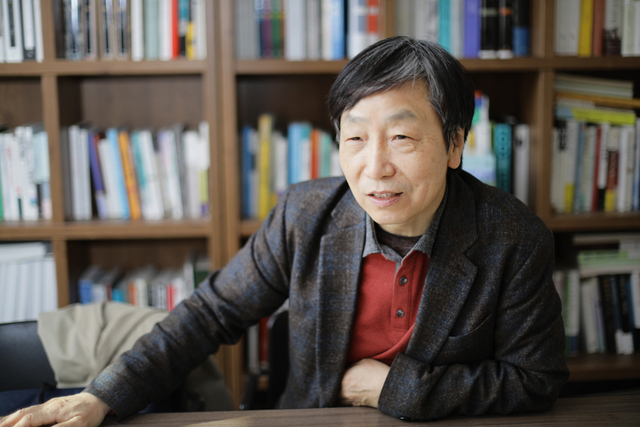
Jong-sung You is Director of the Korea Inequality Research Lab(KIRL) and Visiting Professor of Public Policy at the Department of Public Administration, at Yonsei University in Seoul.
He received a Ph.D. in Public Policy from Harvard University at age 50. He also holds a MPA from Harvard Kennedy School and a B.A. from Seoul National University. He taught at University of California, San Diego, Australian National University, and Gachon University. He has been continuing to teach and conduct research rigorously even after the mandatory retirement in 2021. Prior to his academic career, he fought for democracy, being imprisoned three times under the authoritarian regimes, and is now officially recognized as a person of national merit for democratization.
His research focuses on inequality, corruption, trust, and social policy, including basic income and pension reform, using both qualitative and quantitative methods. He has published in numerous journals, including the American Sociological Review, Political Psychology, Review of International Political Economy, Regulation & Governance, Journal of Contemporary Asia, Journal of East Asian Studies, 동향과전망(Journal of Korean Social Trend and Perspective), and 한국사회정책(Korea Social Policy Review). His book, Democracy, Inequality and Corruption: Korea, Taiwan and the Philippines Compared, was published by Cambridge University Press in 2015, and its Korean translation (동아시아 부패의 기원: 문제는 불평등이다. 한국 타이완 필리핀 비교연구) was published in 2016. He is currently writing a book on a Feasible Basic Income Plan for South Korea: To Promote Freedom, Equality, and Sustainable Efficiency, and working on public pension reform. He is also pioneering in the use of big administrative microdata for policy research in Korea.
Jong-sung has launched the Korea Inequality Research Lab (KIRL), with a research grant of 1.5 billion KRW (about 1.2 million USD) from the Korean Studies Promotion Service (KSPS), Academy of Korean Studies. Fifteen scholars participating in the lab, including economists, political scientists and sociologists, plan to write ten books on measurement, causes, consequences of inequality and social policy in Korea in comparative perspective.
Featured Works
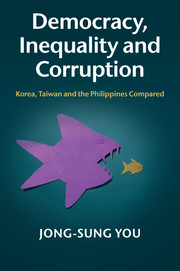
“In this forcefully-argued comparative study of Korea, Taiwan and the Philippines – backed by broader cross-national evidence – Jong-sung You shows how inequality contributes to corruption. The mechanisms include elite capture, patronage and clientelism. This book is an important contribution to the study of inequality, corruption and of the new democracies of East Asia.”
Stephan Haggard, University of California, San Diego
“Professor You’s important work argues that inequality fuels elite corruption and undermines state legitimacy. A key contribution to debates over corruption’s impact on democracy, poverty and growth, especially in Asia.”
Susan Rose-Ackerman, Yale University
A Comparative Study of Inequality and Corruption (2005, with S. Khagram, American Sociological Review 70, 1: 136-157)
This article argues that income inequality increases the level of corruption through material and normative mechanisms. The wealthy have both greater motivation and more opportunity to engage in corruption, whereas the poor are more vulnerable to extortion and less able to monitor and hold the rich and powerful accountable as inequality increases. Inequality also adversely affects social norms about corruption and people’s beliefs about the legitimacy of rules and institutions, thereby making it easier for them to tolerate corruption as acceptable behavior. This comparative analysis of 129 countries using two-stage least squares methods with a variety of instrumental variables supports the authors’ hypotheses using different measures of corruption.
Social Trust: Fairness Matters More Than Homogeneity (2012, Political Psychology 33, 5: 701-721)
This article explores whether homogeneity or fairness better explains generalized interpersonal trust across countries. Although some research suggests that ethnic diversity and income heterogeneity have a negative impact on social trust, I argue that cross‐national variations in social trust are better explained by fairness: fair procedural rules (democracy), fair administration of rules (freedom from corruption), and fair income distribution (relatively equal but also unskewed). This expectation is confirmed by a multilevel analysis of data from the World Values Surveys and European Values Study covering 170,000 individuals in 80 countries.
 Jong-sung You (유종성)